
How to speed up a game of Commander
Nothing in the rules bounds how long a Commander turn may take. A chess clock does, and it is the only fix that acts on the player who actually needs it.
Updated 2026-09-11
Commander games do not run long because the decks are too strong. They run long because nothing in the rules says how long a turn may take, and four unbounded turns compound into an evening. Every fix that works acts on turn time in some way. Most of them only lower the average, and one of them sets a ceiling.
Why do Commander games take so long?
Because a Commander turn has no time limit, and the pod repeats those turns until somebody dies. Common guidance puts a healthy game at roughly 20 minutes per player, which is about 80 minutes for four. Real playgroups routinely report two to three hours, and 30 minutes to three hours or more is the honest range. The gap between the guidance and the reality is turn time, and it compounds: one player who takes an extra five minutes per turn adds half an hour to a six-turn game.
Six things cause most of it.
Tanking.
A player treats a normal turn as a chess puzzle, working out the optimal line while five other people watch. Analysis paralysis is the single largest contributor, and at most tables it is concentrated in one or two players.
Decision fatigue.
Two hours in, everyone is slower. The turns that should be quickest, when the board is settled and the plays are obvious, are often the slowest of the game.
Tutors and shuffling.
Searching a 99-card singleton deck takes real time, and every search ends in a shuffle. Three tutors across a game is ten minutes of nobody playing Magic.
Politics.
Negotiation is a genuine part of the format, and it is also unbounded. A deal that takes 30 seconds to strike sometimes takes four minutes to talk through.
Board complexity.
Permanents and the interactions between them grow faster than the player count. Four boards do not take four times as long to evaluate as one; they take considerably longer, because everything checks against everything else.
Tracking overhead.
Life totals live on dice piles and scrap paper, and somebody has to keep asking what everyone is on. It looks trivial each time, and it happens dozens of times a game, stopping play on every one.
Do Commander brackets tell you how long a game will take?
Not in minutes, and that is where tables get caught out. The bracket system sorts decks by power from Exhibition up to cEDH, and each bracket carries an expected turn count: a floor for how many turns should pass before anyone wins or loses.
| Bracket | Expected game length | Individual turns in a four-player pod |
|---|---|---|
| Exhibition (1) | At least 9 turns | 36 |
| Core (2) | At least 8 turns | 32 |
| Upgraded (3) | At least 6 turns | 24 |
| Optimized (4) | At least 4 turns | 16 |
| cEDH (5) | Can end on any turn | None |
That middle column counts turns rather than minutes, and every number in it is a floor rather than a target. A bracket 2 pod has agreed that nobody should be winning before turn eight, which at four players means 32 individual turns before the game is even supposed to end. At three minutes a turn that is over an hour and a half, and bracket 2 turns are rarely three minutes. The lower brackets are defined around low-pressure, proactive play and win conditions that accrue incrementally, which is the profile that makes a single turn slow.
So the bracket number moves both halves of the equation together. Lower brackets mean more turns and slower ones, while higher brackets mean fewer turns and, at the top, games that can end out of nowhere. A pod grinding out three hours of bracket 2 and a pod finishing bracket 4 inside the hour are both playing the game they agreed to.
Picking a bracket settles deck power. It tells you roughly how many turns the game should last and nothing at all about how long any one of those turns may take.
How to actually bound the game
Give every player their own clock. It is borrowed directly from chess, where the same mechanism has bounded game length for well over a century, and it is already normal at the competitive end of Magic. cEDH events commonly run 75, 80 or 90-minute rounds, with various rules for what happens when the round ends: finish the active turn and then draw, give everyone one extra turn, or allow a capped extension.
Those round timers solve the tournament's problem, which is scheduling. They guarantee the event finishes on time and say nothing about the player whose turns take 15 minutes, who in a slow round has effectively decided how much Magic everyone else gets to play.
A per-player clock bounds each player instead, and it charges the time to whoever spent it. A single countdown for the whole table punishes four people for one person's turn, and the fastest player at the table is the one who loses most when it expires.
How does a chess clock work in Commander?
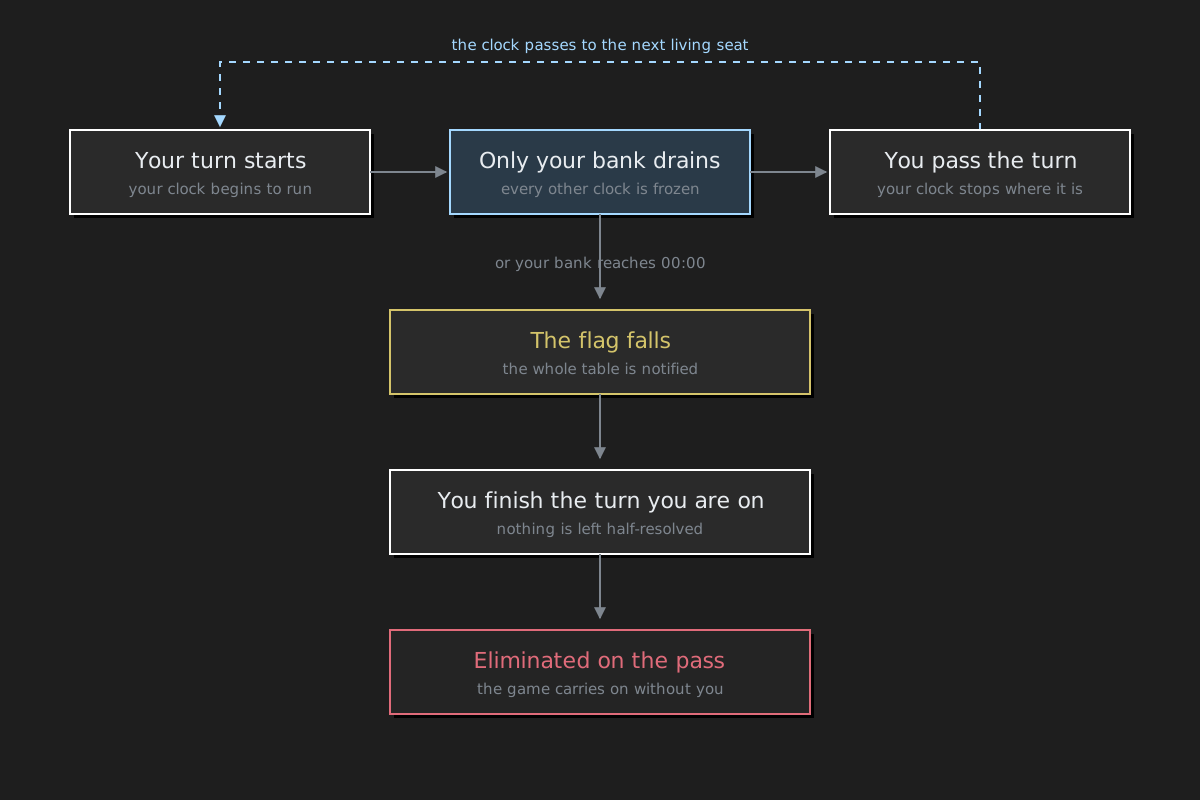
Each player gets an identical bank of time, agreed before the game, that drains only while it is their turn. Everyone else's bank is frozen. Passing the turn stops your clock and starts the next player's, following seat order.
Setup is free. Shuffling and mulligans happen before anything is running, so nobody burns their bank on a double mulligan. The clock is armed but not ticking until the first player starts it.
You can also pause. When the table stops for a rules question, or your turn stalls because someone else has a decision to make in response, the clock should not be punishing you for waiting. Pausing is part of how the clock is meant to be used.
How much time should each player get?
Between 20 and 30 minutes each covers most pods, and 45 minutes suits a group that likes long, grindy games. Pick the bank from how your table plays.
The ceiling is the bank multiplied by the number of players:
| Bank per player | 3 players | 4 players | 5 players | 6 players |
|---|---|---|---|---|
| 20 minutes | 1h 00m | 1h 20m | 1h 40m | 2h 00m |
| 30 minutes | 1h 30m | 2h 00m | 2h 30m | 3h 00m |
| 45 minutes | 2h 15m | 3h 00m | 3h 45m | 4h 30m |
Those are the worst cases. Most players finish a game with a large chunk of their bank untouched, because most turns take two or three minutes and the bank was sized for the outlier. Four players on 30 minutes caps turn time at two hours in the absolute worst case, and typically lands well under that.
The bank is there for the outlier, and if your table does not have one the clock will sit unnoticed all game.
What happens when a player's clock runs out?
The flag falls at zero, that player finishes the turn they are on, and they are eliminated when they pass. Nothing stops mid-turn.
The delay is deliberate. Stopping mid-turn leaves a half-resolved board and an argument to go with it: attackers declared with no blockers, or a spell sitting on the stack with nobody agreed on what it does now. Finishing the turn and leaving on the pass produces a clean board state and a rules situation everyone already understands, because it is identical to any other elimination.
After that, the game continues normally. The remaining players carry on with their own banks untouched, the eliminated player's permanents leave as they would in any elimination, and the loss is recorded like any other.
The more useful effect happens long before the flag falls. Everyone can see everyone's remaining time, so the table watches a player run low in real time. That changes behaviour on its own. People speed up when they can see the number, and they do it without anyone at the table having to ask. Most games with a clock end without a single flag falling, which is the outcome you want.
Does a chess clock ruin casual Commander?
Not if the bank is generous, though it is a poor fit for some tables and it is worth being honest about which. Four objections come up, and three of them have straightforward answers.
"It makes the game feel competitive."
A generous bank is invisible to everyone except the person who was already the problem. If your turns take three minutes, a 45-minute bank is a number you glance at twice per game. The player who notices it is the one taking 15-minute turns.
"It punishes newer players."
Set it to 45 minutes and it does not. It is also worth checking the assumption: new players are usually not the slow ones. They have simple decks and few options. The slowest player at most tables is the experienced one with the most complex build and the most lines to evaluate.
"Politics needs time."
Pause the clock for table-wide discussion. Negotiation involves everyone, so it is not fair to charge it to whoever happens to be the active player, and pausing costs nothing.
"I will feel rushed."
You will for the first game and then you will stop, because nobody plays to the bank. People play at their usual speed and finish with time left over.
There is a real exception. If your table does not mind three-hour games, a clock solves a problem you do not have, and some groups turn up specifically for the long grindy game. Leave it off.
Eight other ways to speed up a Commander game
These all work, and they are all palliative. Each one lowers the average without putting a ceiling on anything. Do them anyway: they are what makes a clock comfortable to play under.
Know your list and cut the tutors.
Searching a 99-card singleton deck is dead time, and every tutor ends in a shuffle for you and a cut for someone else. Two tutors is fine; seven is a pacing decision you made at deckbuilding.
Resolve your end step and upkeep promptly.
Holding the table while you work out what your five triggers do costs the same as a slow main phase, and it happens twice per turn cycle instead of once.
Bound the pre-game.
Pre-shuffle and pre-sleeve before you sit down, and settle the format and power level in advance. Some tables lose fifteen minutes before the first land drop.
Stop tracking life on dice and scrap paper.
Reconstructing the board state is a real, recurring tax, and it is invisible because it never happens all at once. Every "wait, what is your life total?" stops play. Shared life tracking and a proper commander damage matrix mean nobody has to remember which die was the 21st point.
Play more interaction, not less.
This is the counterintuitive one. Removal and counterspells feel like they extend games because they undo other people's work, but they end games: they stop the combo and let somebody's attack actually finish a player. It is the durdling that costs time, not the answers. A pod with no interaction plays out its whole library one value trigger at a time.
Name analysis paralysis out loud.
Agree a per-turn timeout as a table before the game starts. Saying "we call it at 60 seconds" in advance is a rule; saying it on turn nine is an accusation.
Cap the pod at four.
Turn cycle length is the single biggest multiplier on game time, and going from four to six players adds 50 per cent to every cycle. If you have five or six, splitting into a four and a three-player pod usually finishes both games faster than one big one.
Lower deck complexity rather than power level.
A deck stuffed with triggers and modal choices is slower than a stronger, cleaner one. Tables argue about power level constantly and almost never about complexity, even though complexity is what costs them time.
One note on the sixth item: a per-turn timeout is a different mechanism from a chess clock. Manatable has both, and the turn timeout is a one-off 60-second countdown any player can put on another player for a single slow turn. It is not connected to the time banks.
What does not work
Four common suggestions fail for structural reasons.
Banning "slow" decks.
This starts a social fight about which deck qualifies, and it does not fix the behaviour. The same player is slow with a different deck.
Telling someone to play faster.
It makes people anxious, and anxious players get slower. It also has to be repeated every game, which turns one person into the table's timekeeper.
A single shared table timer.
It bounds the session, but it charges everyone for one player's turn, so the whole pod runs out together no matter who spent the time.
An all-aggro pod.
It shortens some games, but it changes what you are playing rather than how long a turn takes. Tables get bored of it within a month, and the pacing problem comes back.
Running a chess clock on Manatable
Manatable has a per-player chess clock built in, and it is off by default. The host enables it in the lobby before the game starts, and there is no way to switch it on mid-game, so it is always a decision the table made together before anyone was running slow.
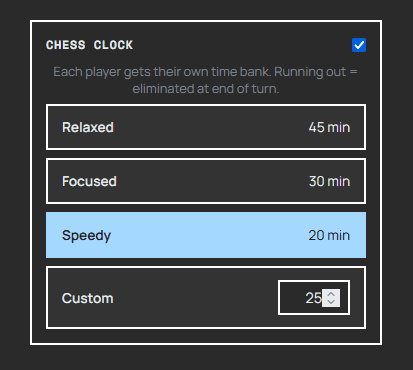
Pick a preset or set your own bank:
| Preset | Bank per player | Suits |
|---|---|---|
| Relaxed | 45 minutes | Casual tables and newer players |
| Focused | 30 minutes | Most four-player pods |
| Speedy | 20 minutes | Groups who want a game inside two hours |
| Custom | 1 to 180 minutes | Anything else |
Ticking the box defaults to Speedy at 20 minutes, so change it if that is not your table.
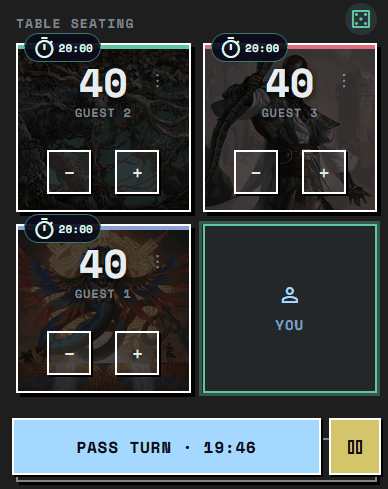
At game start the clock is armed but paused. Setup and mulligans cost nothing. The first player taps Start Game Clock, which then reads Pass Turn for everyone after them, and from that point only the active player's bank drains while every other bank is frozen. Turn order follows the table's seating rotation and skips eliminated players, so the clock and the seat map never disagree.
Start, pass, pause and resume all live on the active player's bar, so the controls are always in front of whoever the clock is actually costing. Passing the turn is blocked while paused, and the server enforces it. Once the clock is running the host also gets their own Pause Clock button: if someone's phone dies mid-game, the host can stop the clock so nobody bleeds time while it gets sorted out, then resume once they are back.
Remaining time appears on every player's seat and life card and updates for everyone at once through the same real-time sync as the rest of the table, which is what lets the pod watch someone run low. When a bank hits zero the whole table is notified, the player finishes the current turn, and they are eliminated on the pass with the cause recorded as Clock.
If a game crashes and is revived, it comes back paused, so nobody bleeds time during an outage.
Afterwards, the game's stats and history include a per-player turn-time breakdown: total time used, number of turns, average, slowest and fastest. That is often more useful than the clock itself. It settles who the slow player actually is with a number, which is a much shorter conversation than the one your table is currently having.
The clock is independent of game mode, so it works with standard Free-for-All and with the Standoff, Star and Kingdoms modes alike. If someone else has already set the table up, you only need the room code to join.
Common questions
- How long should a game of Commander take?
- Common guidance puts a healthy Commander game at roughly 20 minutes per player, so about 80 minutes for a four-player pod. Real playgroups routinely report two to three hours instead. The honest range is 30 minutes to three hours or more, and the difference is almost entirely turn time rather than deck power.
- What is a chess clock in Magic: The Gathering?
- A chess clock gives every player their own bank of time that drains only while it is their turn. Everyone else's bank is frozen until the turn passes to them. If a bank reaches zero the flag falls: that player finishes the turn they are on and is eliminated when they pass. It is borrowed from chess, where the same mechanism has bounded game length for over a century.
- How much time should each player get in a Commander chess clock?
- Between 20 and 30 minutes each works for most pods, and 45 minutes suits groups who like long, grindy games. The bank is a ceiling rather than a target, so most players finish well under it. Four players on 30 minutes each caps total turn time at two hours even in the worst case.
- What happens when your clock runs out in Commander?
- The flag falls at zero, and the player finishes the turn they are currently on instead of stopping mid-turn. They are eliminated when they pass. Ending on the pass avoids a half-resolved board, an argument about a spell on the stack, and any rules ambiguity about what happens next.
- Does the clock run during other players' turns?
- No. Only the active player's bank drains, and every other bank is frozen. That is what separates a per-player clock from a shared table timer. Time you spend thinking on someone else's turn, responding to their spells, or negotiating a deal does not cost you anything.
- Do chess clocks work for casual Commander?
- Yes, provided the bank is generous. A 45-minute bank is invisible to everyone at a casual table except the one player who was already taking 20-minute turns. If your group genuinely does not mind three-hour games, a clock solves a problem you do not have and you should skip it.
- Is there an official time limit in Commander?
- No. The Magic Comprehensive Rules place no limit on how long a turn or a game may take. Competitive events impose their own round timers, commonly 75, 80 or 90 minutes, but that is tournament structure rather than a rule of the format. Casual Commander has no bound at all unless a table adds one.
- How long does a Commander game take by bracket?
- Brackets set an expected turn count rather than a time limit. Exhibition and Core games are meant to run at least nine and eight turns, Upgraded at least six, and Optimized at least four, while cEDH can end on any turn. Those are floors rather than targets, so a four-player bracket 2 pod is agreeing to at least 32 individual turns before anyone is supposed to win. Lower brackets also tend to have slower turns, so they run long on both counts.