
Commander variants: how to play every multiplayer format
Pick a format for tonight's player count. Rules, win conditions, and which ones are official.
Updated 2026-08-04
How to play Commander with 3 players
Three-player pods collapse into a two-on-one. Standoff fixes that by ending the game on the first kill.
Read the guide5 playersHow to play Star format
Five players in a ring. You can only attack the two sitting opposite you, and the two beside you are allies.
Read the guide5-6 playersHow to play Kingdoms
Hidden roles for five or six players. Only the King is public, and everyone else is guessing.
Read the guideThere are more ways to play multiplayer Commander than most tables ever try. Some are written into the Magic Comprehensive Rules, most are house formats that spread because they solved a problem. The one that suits you tonight mostly depends on how many people are sitting down.
This page covers the practical options from three players to six, what each one needs, and how you win. Three of them have full guides: Standoff for three players, Star for five, and Kingdoms for five or six.
Which Commander variant should you play?
Start with how many players you have. That rules out more than anything else does.
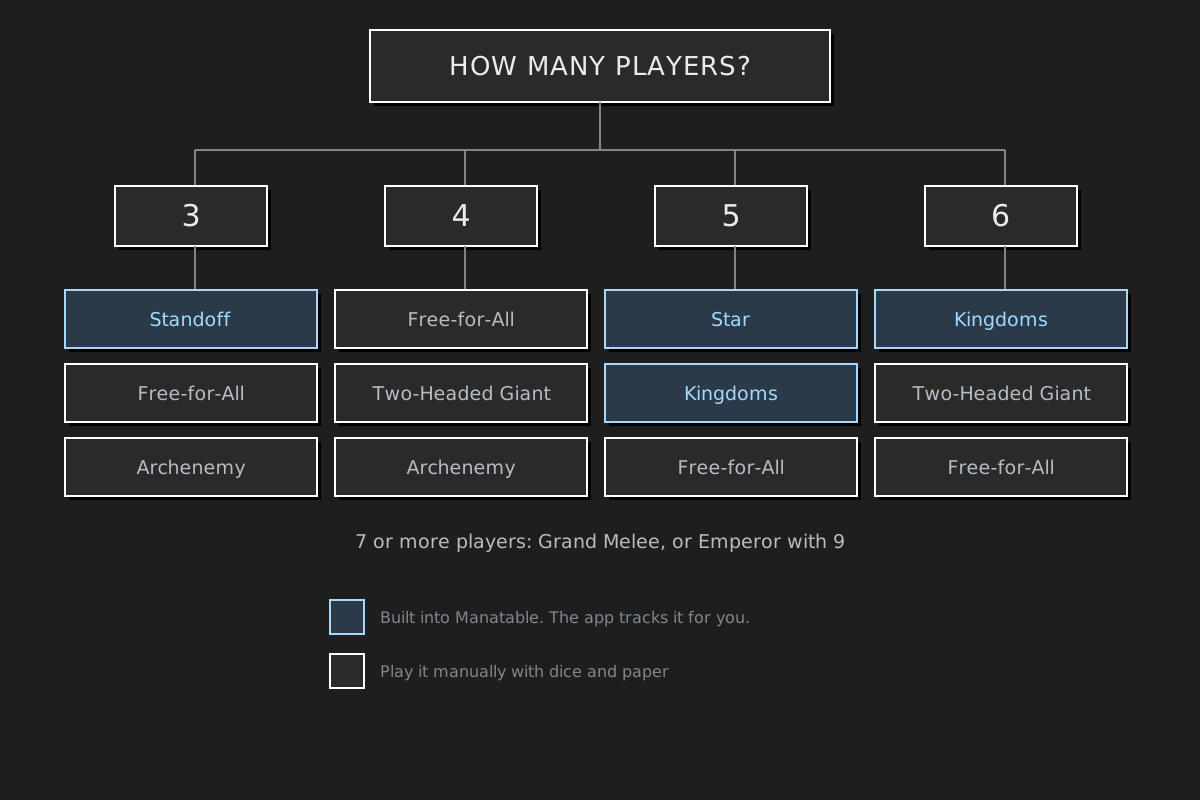
| Players | Worth playing | Why |
|---|---|---|
| 3 | Standoff, Free-for-All, Archenemy | Free-for-All collapses into a two-on-one. Standoff removes the reward for piling on. |
| 4 | Free-for-All, Two-Headed Giant, Archenemy | Four is where plain Free-for-All works best. Two-Headed Giant needs even teams. |
| 5 | Star, Kingdoms, Free-for-All | Five is awkward for a free-for-all and ideal for both Star and Kingdoms. |
| 6 | Kingdoms, Two-Headed Giant, Free-for-All | Six-player free-for-all has long turn cycles. Roles and teams keep everyone involved. |
| 7+ | Grand Melee, Emperor | Both exist specifically to make very large games playable. Emperor needs exactly nine. |
Every variant compared
| Variant | Players | Starting life | How you win | Official? |
|---|---|---|---|---|
| Standoff | 3 | 40 | Most life left when the first player dies | House format |
| Star | 5 | 40 | Eliminate both enemies across the ring | Community format |
| Kingdoms | 5-6 | King 50, others 40 | Depends on your hidden role | Community format |
| Free-for-All | 3+ | 40 | Last player standing | Rule 806 |
| Grand Melee | 7+ | 40 | Last player standing | Rule 807 |
| Team vs. Team | 4+ | 40 | Eliminate the other team | Rule 808 |
| Emperor | 6 or 9 | 40 | Kill the opposing Emperor | Rule 809 |
| Two-Headed Giant | 4, 6 | 30 shared | Reduce the other team to 0 | Rule 810 |
| Alternating Teams | 4, 6 | 40 | Eliminate the other team | Rule 811 |
| Archenemy | 3+ | 40 | The archenemy beats the team, or the team beats them | Supplemental product |
| Oathbreaker | 2-6 | 20 | Last player standing | Community format |
"Official" here means the variant is defined in the Magic Comprehensive Rules. It says where the rules are written down and nothing about quality. Star and Kingdoms have been played for years without appearing in any rulebook.
The three-player problem
Three-player Commander is legal and needs no rules changes, and it still tends to produce bad games. Whoever builds the strongest board draws attacks from both opponents, and whoever wins that two-on-one usually wins the game. The format punishes the leader rather than rewarding good play.
Standoff is the fix. The game ends the instant the first player is eliminated, and the surviving player with the highest life total wins. Killing someone no longer helps you unless you are already ahead on life, because it ends the game while your remaining opponent is still healthy.
The result is a genuine standoff. Everyone wants somebody else to take the first kill, and nobody wants to be the one who drops below the other survivor.
Five players: Star or Kingdoms?
Both are built for exactly five, and they solve different problems.
Star is about seating. Sit five players in a ring and each of them can only attack the two people sitting opposite. Your immediate neighbours are allies your creatures cannot touch. That cuts a chaotic five-way game into a set of defined fights while keeping everyone at the same table, and the pairings draw a five-pointed star, which is where the name comes from.
Kingdoms is about information. Everyone is dealt a secret role with its own win condition. Only the King is public, sitting on 50 life with a target on their back, and nobody else knows who is protecting the crown and who is hunting it. It plays like a social deduction game bolted onto Commander.
Pick Star if your group wants a cleaner fight and a format you can teach in a minute. Pick Kingdoms if they enjoy bluffing and do not mind that one game in five is decided by the roles rather than the decks.
The official variants worth knowing
Free-for-All is what almost everyone means by multiplayer Commander. Everyone plays for themselves, you may attack anyone, and the last player standing wins. It is rule 806 and it is a good default at four players.
Two-Headed Giant puts players in teams of two who share a life total, share turns, and are attacked as a unit. It starts at 30 shared life rather than 40 each, and it is by some distance the most beginner-friendly variant here, because a newer player always has a teammate to ask.
Emperor puts three players a side in a row, with the Emperor in the middle protected by two generals. Only the generals can attack at the start, and you win by killing the enemy Emperor. It needs six or nine players, which is what keeps it rare.
Grand Melee exists for very large games. Multiple players take turns simultaneously and you can only attack the player to your left, which stops a fifteen-person game from taking an entire evening.
Team vs. Team and Alternating Teams are the straightforward team variants, the second seating players so that no two teammates sit next to each other.
Variants that need extra components
Archenemy sets one player against everyone else, with the solo player drawing from a deck of oversized scheme cards to make up the difference. It works at any player count from three up and is the best answer when one deck at the table is clearly stronger than the rest.
Planechase adds planar cards that change the rules for everyone until somebody rolls the planar die and moves the game somewhere else. It layers onto any of the variants above rather than replacing them.
Oathbreaker is a different deckbuilding format rather than a seating variant: a planeswalker commander, a signature spell, 58 other cards and 20 life. It plays faster than Commander and suits groups who find 40 life too long.
Playing these on Manatable
Manatable is a live game tracker for Commander. Everyone joins the same table from their own phone, and life totals, commander damage, counters and tokens stay in sync without anyone maintaining a spreadsheet or a pile of dice.
Standoff, Star and Kingdoms are built in. The host picks the mode in the lobby, the app applies the rules that are easy to get wrong, and it works out who won. That means the first-kill ending in Standoff, the seating pairings and joint wins in Star, and the hidden role deal, the King's 50 life and the throne claim in Kingdoms.
The variants this page describes that are not built in still work perfectly well on a standard table. Free-for-All is the default mode, and Archenemy or Planechase only need you to track life, which the app does anyway.
Create a free table or join one with a room code. The game modes feature page has the shorter version of what the app does.
Common questions
- What are the official Magic multiplayer formats?
- The Magic Comprehensive Rules define six multiplayer variants in sections 806 to 811: Free-for-All, Grand Melee, Team vs. Team, Emperor, Two-Headed Giant and Alternating Teams. Everything else, including Star, Kingdoms, Standoff and Archenemy's usual Commander pairing, is a community or house format.
- What is the best Commander format for 5 players?
- Star and Kingdoms are both built for five. Star gives everyone two fixed enemies across a seating ring, which cuts the table into manageable fights. Kingdoms deals hidden roles with different win conditions, which suits groups who enjoy bluffing. Star is the easier one to teach.
- How do you stop 3-player Commander being a two-on-one?
- Play Standoff. The game ends the moment the first player is eliminated and the survivor with the highest life wins, so ganging up on the leader stops being profitable. Taking a kill hands the win to whoever is healthiest.
- How many players can play Commander at once?
- There is no upper limit in the rules, but a free-for-all stops being fun somewhere around six because turn cycles get too long. Above six, Grand Melee or Emperor exist for exactly that reason, and both change the rules about who you can attack in order to keep the game moving.
- Do Commander variants need special cards?
- Most do not. Standoff, Star, Kingdoms and Free-for-All all use normal Commander decks with no additions. Archenemy needs a scheme deck, and Planechase needs planar cards. Kingdoms needs something to deal hidden roles with, though any five index cards will do.