
How to play Star format
Five players in a ring. You can only attack the two sitting opposite you, and the two beside you are allies.
Updated 2026-08-04
Star is a five-player Commander variant played in a ring. Each player has two enemies, the players sitting two and three seats away, and two allies, the players either side of them. You win by eliminating both of your enemies. Your creatures cannot attack your allies at all.
Draw lines between every pair of enemies and you get a five-pointed star, which is where the format takes its name. Some groups call it Pentagram or Five-Point.
What do you need to play Star?
Five players, exactly. Not four, not six. Everyone starts on 40 life with normal Commander decks, and no extra components are needed.
The one thing you cannot improvise is the player count. Star's entire structure comes from the geometry of a five-seat ring, and the format does not degrade gracefully. With six players you want Kingdoms; with three, Standoff.
Setting up
- Seat five players in a ring and number the seats 1 to 5 in order.
- Set everyone to 40 life.
- Work out your two enemies: count two seats one way, then three seats the same way. Those two players are the only ones your creatures may attack.
- Confirm the pairings out loud before the first turn. Everyone should be able to name their two enemies and their two allies.
- Determine the starting player and play as normal.
Step 4 is worth the thirty seconds. Almost every argument in a Star game comes from someone attacking a player they thought was an enemy three turns ago.
Who can you attack in Star format?
The two players sitting across the ring from you. Your immediate neighbours on both sides are your allies, and your creatures can never attack them.
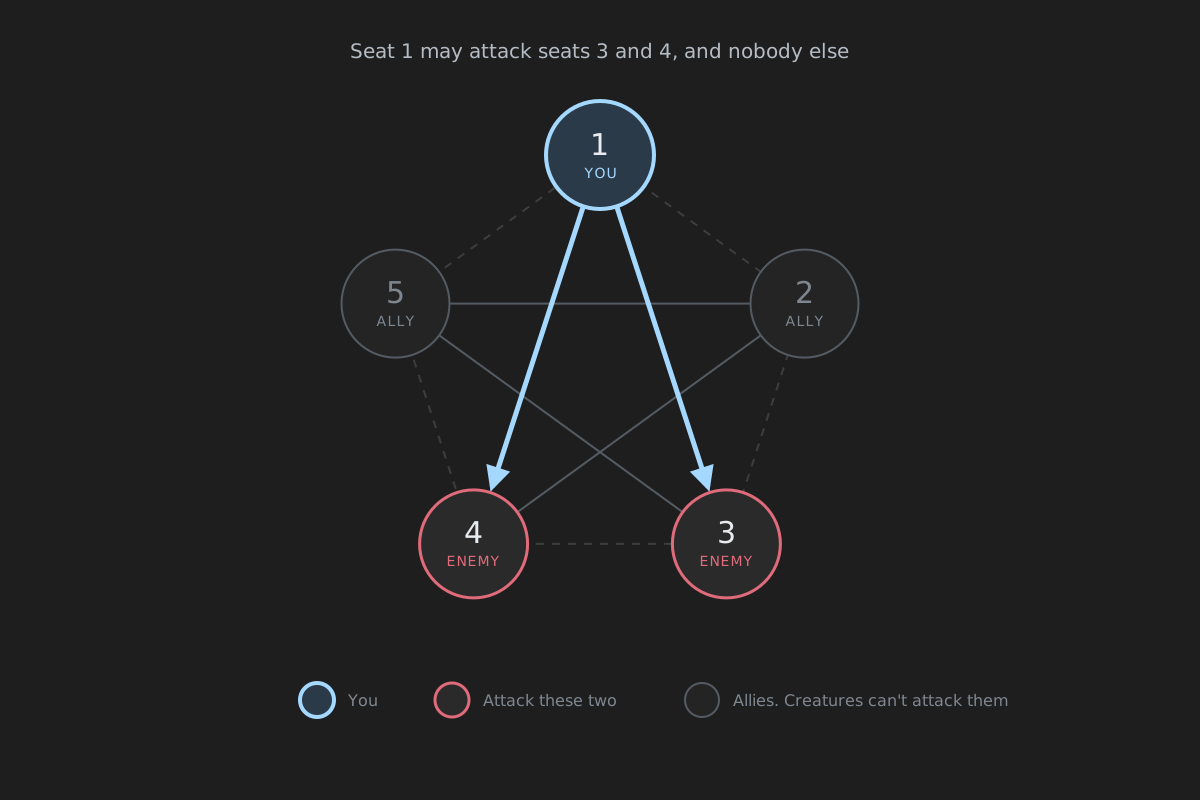
Every seat, written out:
| Your seat | Your two enemies | Your two allies |
|---|---|---|
| 1 | 3 and 4 | 2 and 5 |
| 2 | 4 and 5 | 1 and 3 |
| 3 | 5 and 1 | 2 and 4 |
| 4 | 1 and 2 | 3 and 5 |
| 5 | 2 and 3 | 1 and 4 |
Two things fall out of that table that are easy to miss. The relationship is symmetric, so if seat 3 is your enemy then you are seat 3's enemy. And each of your allies shares exactly one enemy with you. In seat 1, your ally in seat 2 also wants seat 4 dead, and your ally in seat 5 also wants seat 3 dead. Those overlaps are where the deals get made.
What can you still do to an ally?
Creatures cannot attack allies. Everything else can still reach them. A targeted removal spell, a burn spell, a sacrifice effect or an edict can all be pointed at an ally, and there is nothing stopping you.
The important restriction is a different one. Your allies are not your opponents. Any card that reads "each opponent" or "target opponent" applies only to your two enemies. A spell that drains each opponent for 3 hits two players in Star, not four. A board wipe, which does not use the word opponent, still hits everything.
This is the rule new players forget, and it changes card evaluation substantially. Symmetrical punisher effects get much weaker; targeted removal gets much better.
How do you win Star format?
Eliminate both of your enemies while you are still alive. You do not need to be the last player standing, and you do not need to have dealt the damage yourself. If someone else kills one of your enemies, that still counts.
Two players can win together. Once three players are out, the two survivors are always sitting next to each other, which means they are allies and each of them has had both enemies removed. They win jointly.
If the last two survivors are not adjacent, they are each other's enemies and the game continues until one of them is gone.
A player who has already been eliminated cannot win retroactively. If your enemies both die on the turn after you do, that is bad luck rather than a posthumous victory.
When it goes wrong
Someone attacks an ally.
Back the attack out if you catch it before damage, and let it stand if you do not. The seating is public information and everyone had the chance to check, so relitigating a combat two turns later is worse for the game than eating the mistake.
A player leaves mid-game.
Star does not work with four. Either finish the game treating the departed player as eliminated, which usually resolves it quickly, or stop and start something else. There is no clean way to re-pair a four-seat ring.
Players swap seats.
If you move, your enemies move with you. Re-confirm the pairings before the next turn, because half the table will still be working from the old ring.
An effect makes someone attack a player they cannot attack.
Goad, and cards that force attacks, run into the format's restriction. The simple ruling is that the format restriction wins: if there is no legal enemy to attack, the requirement cannot be met and the creature does not attack. Agree this before you start if your decks are full of goad.
Playing Star on Manatable
Manatable works out the pairings from the seating and shows them on the wheel, so nobody has to count seats mid-combat. Your two enemies stay lit and your allies dim out.
To be clear about what the app does and does not do: it highlights your legal targets, it does not block an illegal attack. Damage still goes wherever you tell it to go. The wheel is there to stop honest mistakes, not to police the table.
The app also handles the win condition, including the joint win when an ally pair is left standing, and it recomputes the pairings if anyone changes seats mid-game.
Create a free table or join one with a room code. See all Commander variants, compare it with Kingdoms, which is the other five-player option, or read the shorter pitch on the game modes feature page.
Common questions
- What is Star format in Magic: The Gathering?
- Star is a five-player Commander variant played in a ring. Each player has two designated enemies, the players sitting two and three seats away, and two allies, the players either side of them. You win by eliminating both of your enemies. Creatures cannot attack allies, though spells and targeted abilities still can.
- Is Star an official Magic format?
- No. Star does not appear in the Magic Comprehensive Rules. It is a long-standing casual format, sometimes called Pentagram or Five-Point. The official multiplayer variants are Free-for-All, Grand Melee, Team vs. Team, Emperor, Two-Headed Giant and Alternating Teams, covered in rules sections 806 to 811.
- Who can you attack in Star format?
- The two players sitting two and three seats away from you around the ring. In a table numbered 1 to 5, seat 1 attacks seats 3 and 4, seat 2 attacks seats 4 and 5, seat 3 attacks seats 5 and 1, seat 4 attacks seats 1 and 2, and seat 5 attacks seats 2 and 3.
- Can two players win Star format together?
- Yes. If three players are eliminated, the two survivors are always sitting next to each other, and each of them has had both of their enemies removed. They win jointly. Two survivors who are not adjacent are each other's enemies, so they keep playing.
- Do allies count as opponents in Star format?
- No. Cards that say each opponent or target opponent skip your allies and apply only to your two enemies. This is the convention that makes the format work, and it is the biggest thing new players forget.
Other variants
How to play Commander with 3 players
Three-player pods collapse into a two-on-one. Standoff fixes that by ending the game on the first kill.
Read the guide5-6 playersHow to play Kingdoms
Hidden roles for five or six players. Only the King is public, and everyone else is guessing.
Read the guide