
How to play Commander with 3 players
Three-player pods collapse into a two-on-one. Standoff fixes that by ending the game on the first kill.
Updated 2026-08-04
Three-player Commander has a structural problem. Whoever looks strongest draws attacks from both opponents, and whoever survives that two-on-one usually takes the game. Standoff removes the pile-on by ending the game the moment one player dies. The surviving player with the highest life total wins.
That single change rewrites the incentives. You no longer want to kill someone. You want to be the healthiest player at the table when somebody else does.
What do you need to play Standoff?
Three players and nothing else. Everyone starts on 40 life, decks are built to normal Commander rules, and there are no extra components or card restrictions. Seating does not matter either, unlike Star, which pins your legal targets to your seat.
Agree on one thing before you shuffle: who is the host. The host settles a tied life total at the end, and it is much easier to nominate them now than to negotiate it while everyone is staring at two players on 23 life.
Setting up
- Seat three players and set everyone to 40 life.
- Nominate a host. Better still, agree in advance which tie-break they will apply.
- Determine the starting player however your group normally does.
- Play Commander as usual.
Nothing about deckbuilding, mulligans, the stack, or the commander tax changes. Standoff only redefines when the game ends and who wins.
How does a turn work in Standoff?
Turns work exactly as they do in any Commander game. You untap, upkeep, draw, and take your main phases in the usual order. You may attack either opponent freely, cast whatever you like at whoever you like, and make whatever deals you want.
What changes is what you want to do rather than what you are allowed to do. Nobody gains from swinging first, so the game settles into a political stalemate where everyone is waiting for someone else to move.
How do you win Standoff?
The game ends the instant the first player is eliminated. Compare the life totals of the two survivors, and the higher total wins.
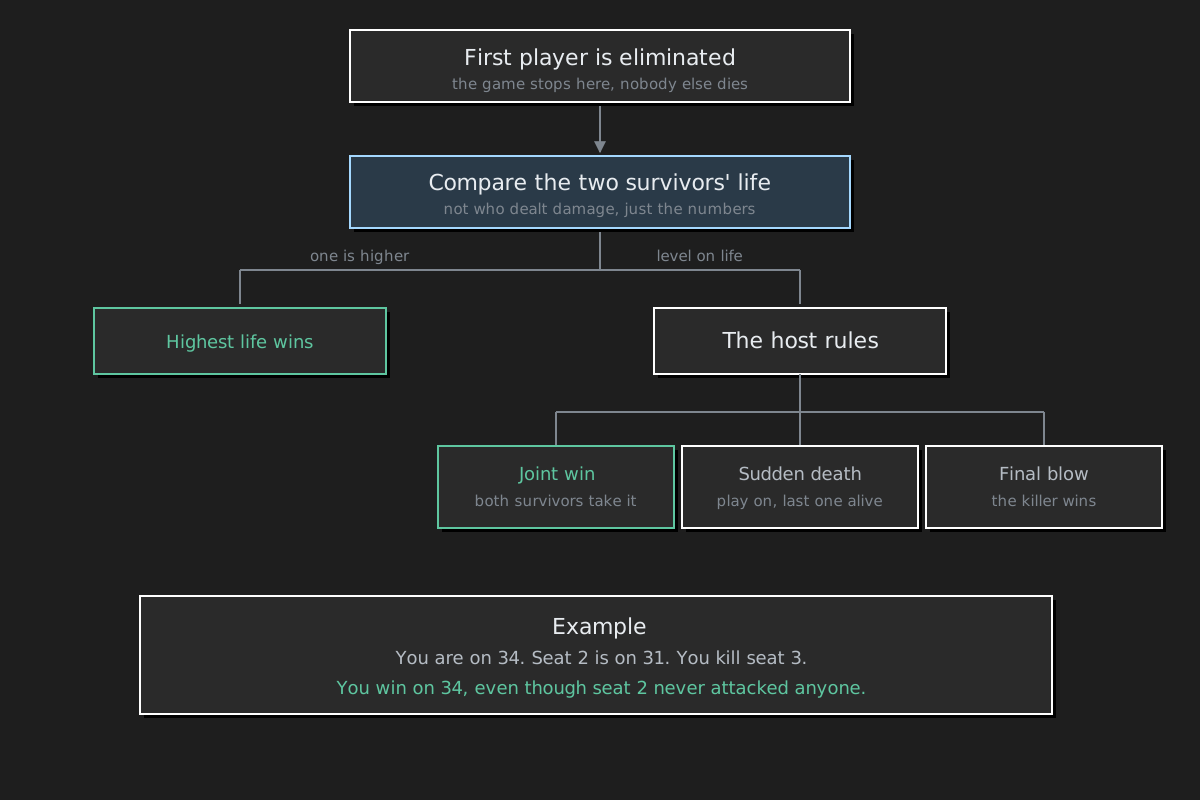
Written out, the sequence is:
- The first player is eliminated. Play stops immediately, mid-turn if necessary.
- Compare the life totals of the two remaining players.
- The higher total wins. Damage dealt, kills taken and board presence count for nothing.
- If they are level, the host rules.
A worked example. You are on 34, the third player is on 31, and you swing to finish off the player who was already at 4. You win on 34, and the player on 31 loses without ever being attacked. Had you waited a turn and taken a hit from them first, you would have handed them the game.
Why does the first kill decide the whole game?
Because taking a kill ends the game while your opponents are still healthy, and the healthiest of them wins. This inverts the usual Commander instinct, where removing a player is almost always good for you.
The practical consequences are what make the format worth playing. Killing the weakest player is only correct when you are already ahead on life, and otherwise you are handing the win to the third player. Chip damage matters far more than it does in a normal pod, because a two-point swing decides games that a 40-point commander hit would not. Most of all, a player on low life stops being a free kill and becomes something nobody wants to touch, since finishing them off ends the game on the spot.
What happens if two players tie on life?
The host picks one of three rulings. All three are legitimate and your table should settle on one before the situation arrives.
| Ruling | What happens | Suits a table that |
|---|---|---|
| Joint win | Both survivors win together. | Wants the game to end cleanly and does not mind sharing. |
| Sudden death | Play resumes. From here the game runs as normal Commander until one player is left. | Wants a single winner and does not mind a longer game. |
| Final blow | The win goes to whoever dealt the killing blow, provided they are one of the tied survivors. | Wants aggression rewarded rather than punished. |
Sudden death is worth understanding before you pick it. Once the host calls it, Standoff's rule is switched off for the rest of the game, and the last player standing wins in the ordinary way. It converts the remaining game into a duel.
The final blow ruling only applies if the player who dealt the killing blow is one of the tied survivors. If the eliminated player was killed by an effect nobody controlled, or by the other tied player, there is nobody to award it to and the host has to pick one of the other two.
When it goes wrong
Someone concedes.
A concession is an elimination, so it ends the game exactly as a kill would. If a player scoops in frustration on turn four, the healthier of the other two wins. Say this out loud before you start, because it catches people.
Two players die simultaneously.
A board wipe or a symmetrical effect can eliminate two players at once. With only one player left there is nothing to compare, and that player wins. If all three die together, the game is a draw.
A player is eliminated by something other than damage.
Commander damage at 21, ten poison counters, drawing from an empty library, and a card that says "you lose the game" are all eliminations, and any of them ends a Standoff game. The trigger is elimination, not lethal damage.
Life totals change after the kill.
Play stops at the elimination. Triggers that would have resolved afterwards do not get to move the life totals that decide the winner.
Other ways to play Commander with three people
Standoff is not the only option, and it is not always the right one.
Free-for-All is the default and it is a perfectly good game. It is written into the Comprehensive Rules at section 806. It just has the pile-on problem described at the top of this page, which gets worse the longer your games run.
Archenemy turns the pod into two players against one, with the solo player drawing from a scheme deck to compensate. It needs the scheme cards, and it works best when the archenemy is the strongest player or the strongest deck.
Two-Headed Giant does not work with three, since it needs even teams. Star and Kingdoms need five or more. If your third player drops out regularly, Kingdoms is worth a look for the nights when the pod is full.
Playing Standoff on Manatable
Manatable has Standoff built in. Pick it in the lobby when three players have joined, and the app tracks life for everyone, ends the game on the first elimination, and works out the winner from the life totals without anyone having to remember the rule.
When the two survivors are level, the host gets the three rulings as buttons rather than an argument. Sudden death resumes the game properly, so nobody has to reconstruct the board state from memory.
The first time your table plays it, the app shows the rules on screen. Once everyone knows them you can switch that off in settings.
Create a free table or join one with a room code. See all Commander variants, or read the shorter pitch on the game modes feature page.
Common questions
- Can you play Commander with 3 players?
- Yes. Three-player Commander uses the standard rules with no changes. The problem is not legality, it is that the table tends to gang up on whoever is ahead, so the player who survives the two-on-one usually wins. Standoff is a house variant that removes the incentive to pile on.
- How does Standoff work in Magic: The Gathering?
- Standoff is a three-player Commander variant. The game ends the moment the first player is eliminated, and the surviving player with the highest life total wins. If the two survivors are level on life, the host rules the result as a joint win, a sudden death, or a win for whoever dealt the killing blow.
- Is Standoff an official Magic format?
- No. Standoff does not appear in the Magic Comprehensive Rules. It is a house variant built into Manatable. The official multiplayer variants are Free-for-All, Grand Melee, Team vs. Team, Emperor, Two-Headed Giant and Alternating Teams, in rules sections 806 to 811.
- What happens if two players tie on life in Standoff?
- The host chooses between three rulings: both survivors win jointly, the game resumes as a sudden death until one player is left, or the win goes to whoever dealt the final blow. Agree which one your table uses before you start and you will never have to argue about it.
- Does conceding end a Standoff game?
- Yes. A concession is an elimination, and Standoff ends on the first elimination. Anyone who scoops hands the win to whichever of the other two has more life.